
A French kitchen is a bespoke kitchen designed around the range as its permanent architectural centrepiece. It combines a custom French range, handcrafted cabinetry, natural stone surfaces, artisan hardware, and integrated appliances all specified to work together as a single, cohesive design. Unlike a standard kitchen, a French kitchen is built once and maintained for life, not renovated on a cycle.
- A French kitchen is defined by philosophy, not aesthetics - it is built around the range, and designed as permanent architecture.
- The French range is specified first everything else follows from it.
- French kitchens are not a single style. They range from classic Provencal to sleek contemporary what unites them is the approach, not the look.
- Materials are chosen to age well: painted wood, natural stone, unlacquered brass, and stainless steel all develop character over decades.
- A French kitchen is a generational investment designed once, maintained, and passed down.
The phrase "French kitchen" gets used a lot in design media and is used loosely. Sometimes it means a kitchen with a farmhouse sink and linen curtains. Sometimes it means Provencal-inspired cabinetry. Sometimes it means nothing more specific than "European-feeling."
None of those definitions are wrong, exactly. But they miss what a French kitchen actually is at its core: a kitchen designed around a custom French range, built as permanent architecture, and approached as a single coherent design rather than a collection of separate purchasing decisions.
This guide explains what a French kitchen really is: its defining elements, its design philosophy, and how it differs from every other approach to kitchen design.
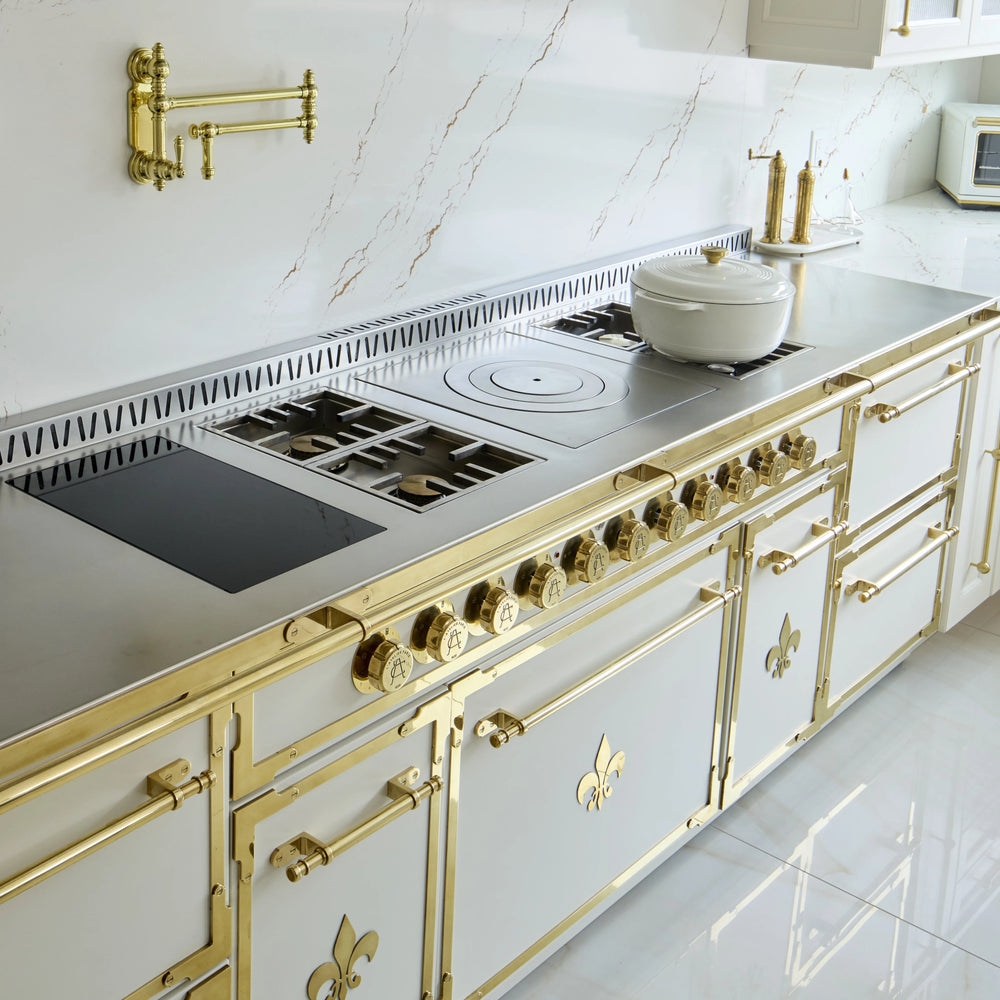
In a standard kitchen renovation, the process typically runs in one direction: design the layout, choose the cabinetry, select the countertops, and then fit whatever appliances remain within the allocated space and budget. The range is treated as a variable in an equation that has already been mostly solved.
A French kitchen reverses that sequence entirely.
The range is specified first. Its width determines the kitchen's proportions. Its colour sets the palette. Its height influences ventilation clearances and ceiling treatment. Its depth affects countertop layout. Every subsequent decision cabinetry style, island placement, material selection, hardware finish is made in relation to the range, not independent of it.
This is not a stylistic preference. It is a practical approach to designing a kitchen that functions as a unified whole rather than a room where the cooking equipment happens to be located.
"We are not selling appliances; we are guiding clients towards permanent architectural decisions."
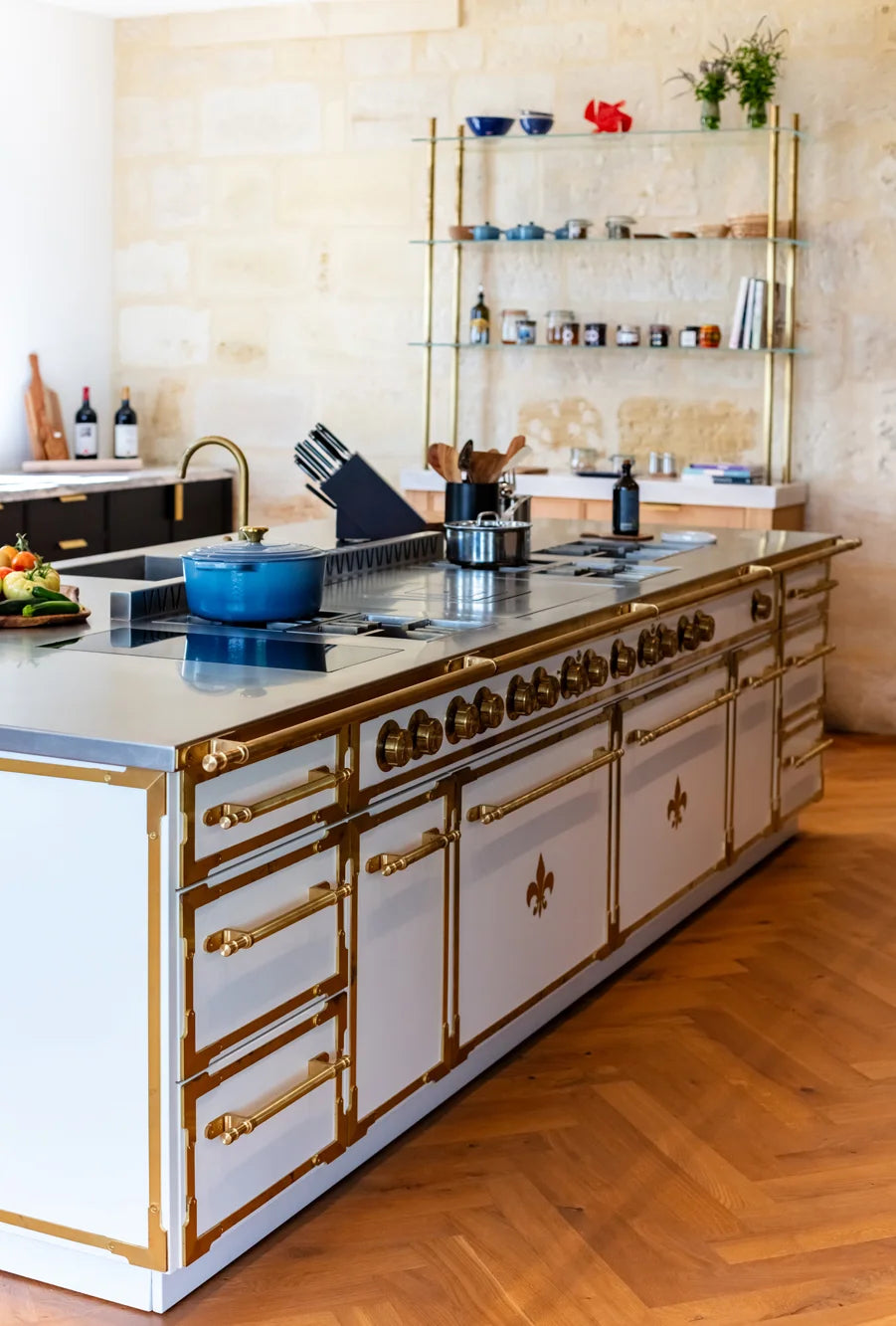
The term 'French range' refers to a professional-grade cooking appliance rooted in the tradition of the French commercial kitchen. It is not defined by a single feature but by a set of characteristics that distinguish it from every retail appliance category. For a full breakdown, see: French range vs. American range.
What is the Coup de Feu?
The Coup de Feu sometimes called a French top is a solid cast steel cooking surface heated from below. It creates graduated heat zones across its surface: extremely hot at the centre, progressively cooler toward the edges. A cook manages multiple pots by sliding them across the plate rather than adjusting burners. It is one of several cooktop configurations available on an L'Atelier Paris range, not the defining feature of the range itself.
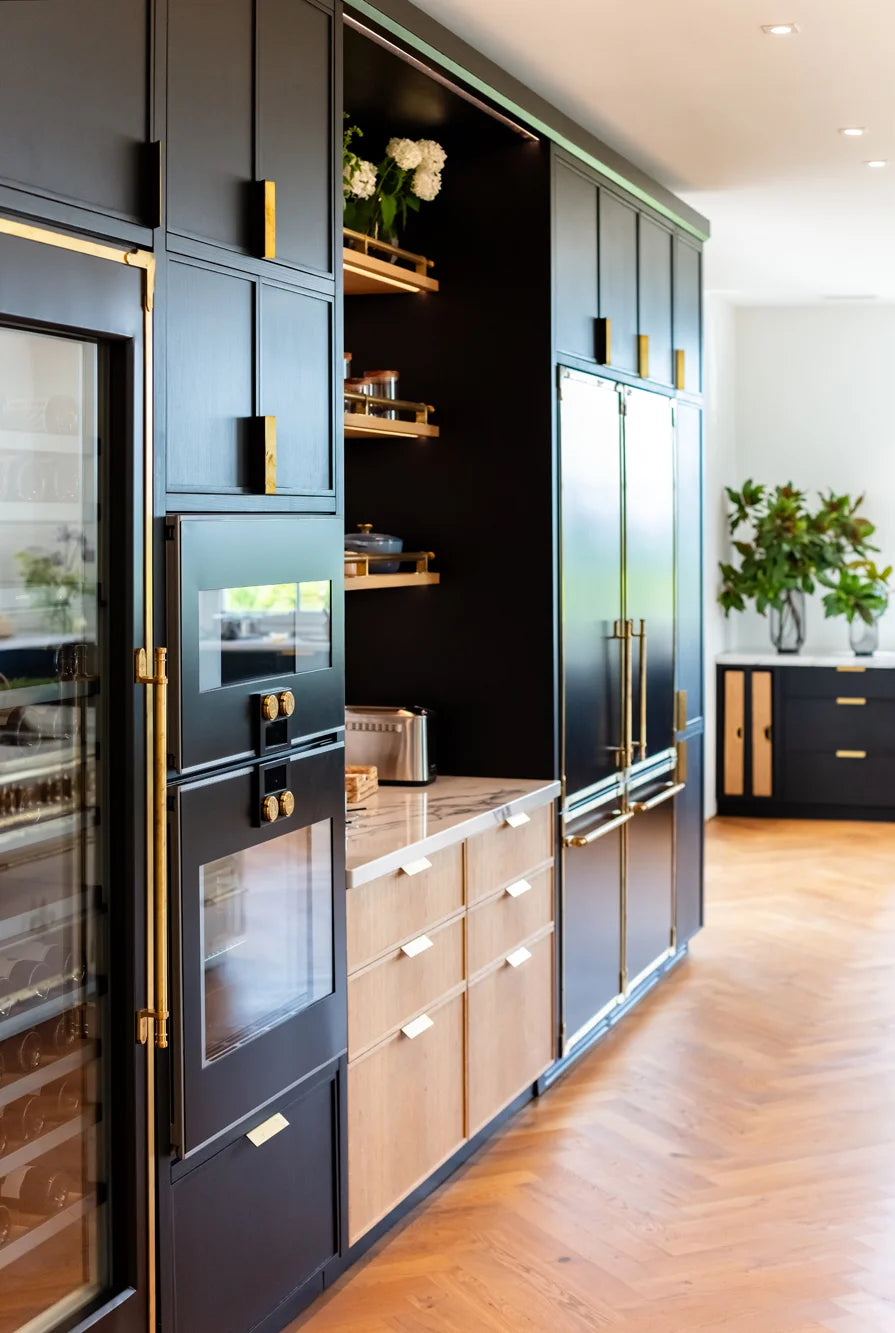
A French kitchen is more than a range surrounded by cabinetry. It is a composition of five elements, each chosen to work with the others as a unified whole.
The centrepiece and starting point. In a French kitchen, the range is visible from every angle of the room and is treated as a piece of architecture rather than an appliance. Its colour, size, and trim finish set the visual language for everything around it.
Custom-built millwork designed to complement the range, not contain it. L'Atelier Paris cabinetry is available in two categories: stainless steel systems (Le Classique, Le Transitionnel, Le Contemporain, Le Linéaire) and wood cabinetry collections (La Brittany, La Provence, La Planche, La Cadre, L'Avignon, Le Rhône, L'Alsace, Le Chevron, Le New York, Le Loire, Le Paris). Both categories are designed to work in direct relationship with the range; the cabinetry style, finish, and hardware are all specified to complement the range's colour and trim.
Countertops, backsplashes, and flooring chosen for how they age, not just how they look when new. Calacatta marble, honed granite, soapstone, and natural stone tile are standard in French kitchens. Stainless steel counters are increasingly specified in professional-style projects. Materials are chosen to develop patina and character over decades.
Solid brass handles, faucets, and fixtures that complement the range's trim finish. In a French kitchen, hardware is never generic; it is specified as part of the design alongside the range, not selected as an afterthought. L'Atelier Paris manufactures its own solid brass handles and pulls, machined by European artisans using traditional techniques.
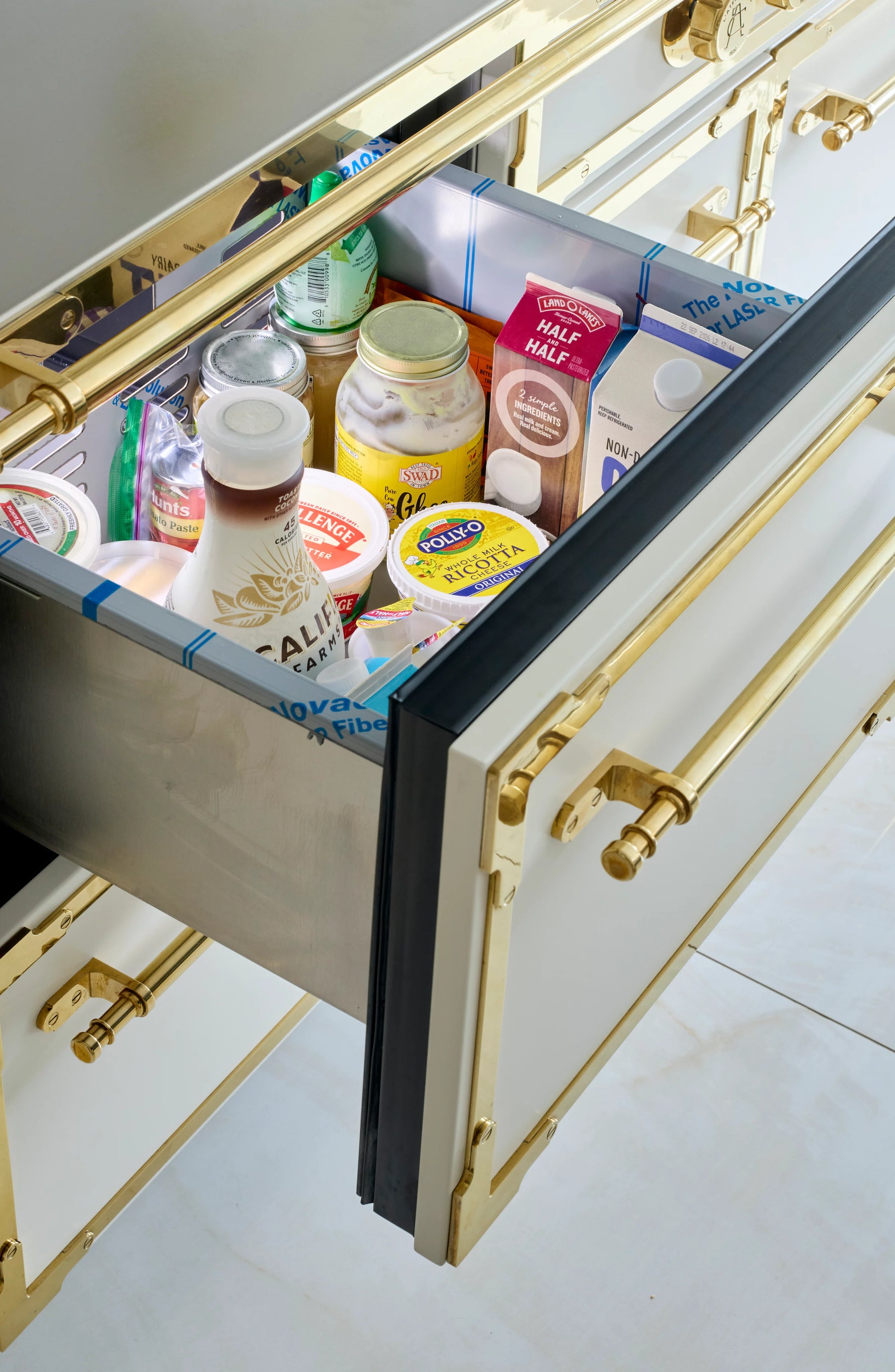
Integrated appliances refrigeration, wine storage, coffee, dishwasher- are concealed behind cabinetry panels to keep the visual focus on the range. In a French kitchen, nothing competes with the range. Every other appliance is designed to disappear into the surrounding cabinetry.
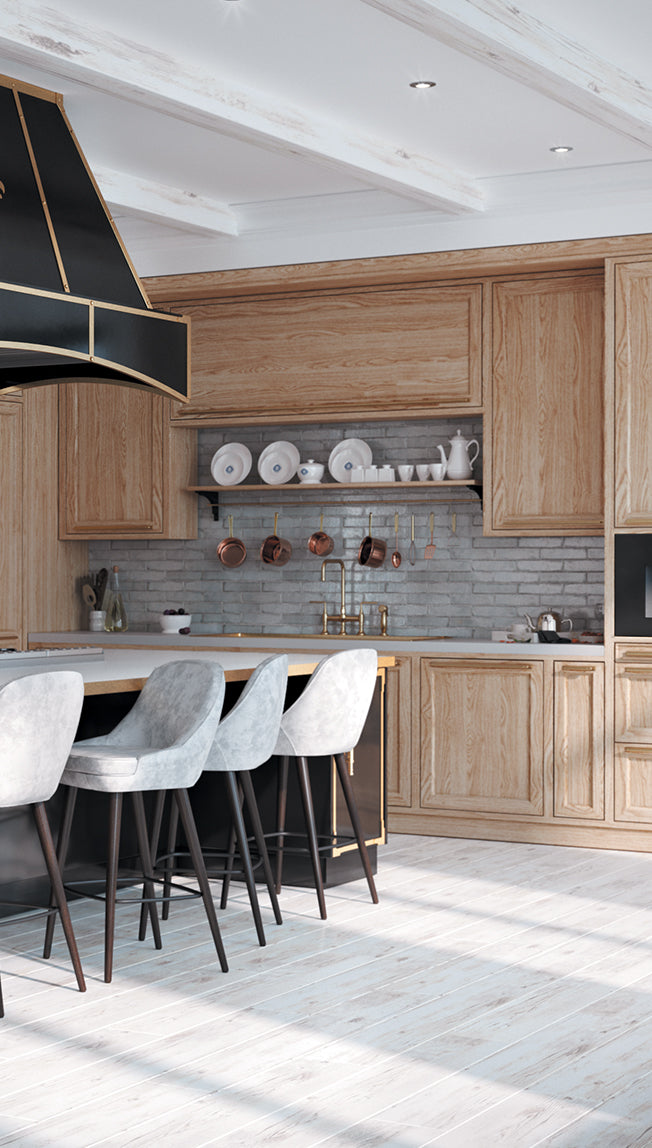
One of the most common misconceptions about French kitchens is that they all look the same — rustic, blue-and-white, farmhouse-adjacent. In reality, the French kitchen is a design philosophy that expresses itself across a wide range of aesthetics. L'Atelier Paris's signature kitchen collections illustrate this range clearly. For a full exploration, see: How to Design a Luxury French Kitchen in 2026.
| Style | Defining characteristics | Typical range colour | Cabinetry |
|---|---|---|---|
| Stainless Steel Cabinetry Collections | |||
| Le Classique | Château-inspired; architectural precision; formal symmetry | White Pearl, Forest Green, or custom | Stainless steel |
| Le Transitionnel | Modern meets classic; bold colour on range; clean stainless backdrop | Navy, Deep Blue, or Noir Black | Stainless steel |
| Le Contemporain | Sleek, minimal, monochromatic; the most architectural expression | Noir Black or custom RAL | Stainless steel |
| Le Linéaire | Clean horizontal lines; refined and understated; urban elegance | Any Signature or RAL colour | Stainless steel |
| Wood Cabinetry Collections | |||
| La Brittany | Rustic Breton warmth; unpretentious, homespun character | Ivory, bone, or soft sage | Wood |
| La Provence | Mediterranean warmth; classic blue tones; relaxed and refined | Provencal Blue or Sage | Wood |
| La Planche | Natural plank-inspired texture; earthy, organic, grounded | Warm naturals or custom | Wood |
| La Cadre | Gallery-inspired; structured, clean-framed panels; premium finish | Any Signature or RAL colour | Wood |
| L'Avignon | Bold contrast of white, black, and natural wood; inspired by ancient Avignon | Noir Black or Deep Charcoal | Wood |
| Le Rhône | Swiss craftsmanship meets French joie de vivre; refined river-valley aesthetic | Warm neutrals or deep tones | Wood |
| L'Alsace | Stately navy and pale tones; formal, light-filled spaces | Deep Navy + pale cabinetry | Wood |
| Le Chevron | Geometric chevron pattern cabinetry; bold texture, refined detail | Any Signature or RAL colour | Wood |
| Le New York | Urban sophistication; grey and white city-skyline palette | Grey, white, or Noir Black | Wood |
| Le Loire | Loire Valley elegance; refined proportions, premium materials | Soft neutrals or classic greens | Wood |
| Le Paris | Metallic finishes meet warm wood; understated Parisian luxury | Anthracite or Noir Black | Wood |
What unites all of these expressions is the same underlying principle: every style begins with the range, and every design decision follows from it. The look changes. The philosophy does not.
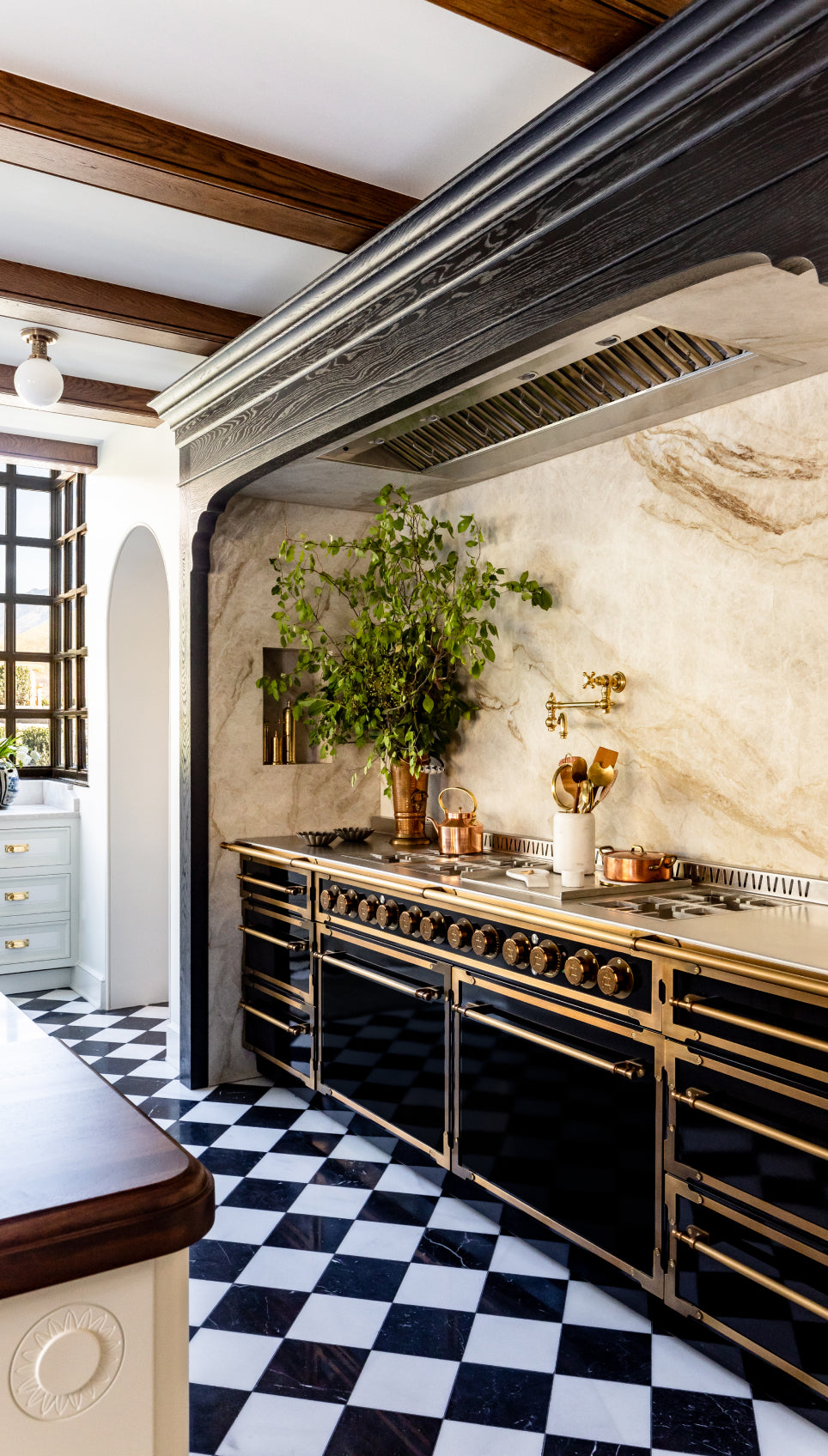
Understanding what a French kitchen is requires equal clarity about what it is not. Several things commonly associated with 'French kitchen design' are aesthetic references rather than defining characteristics:
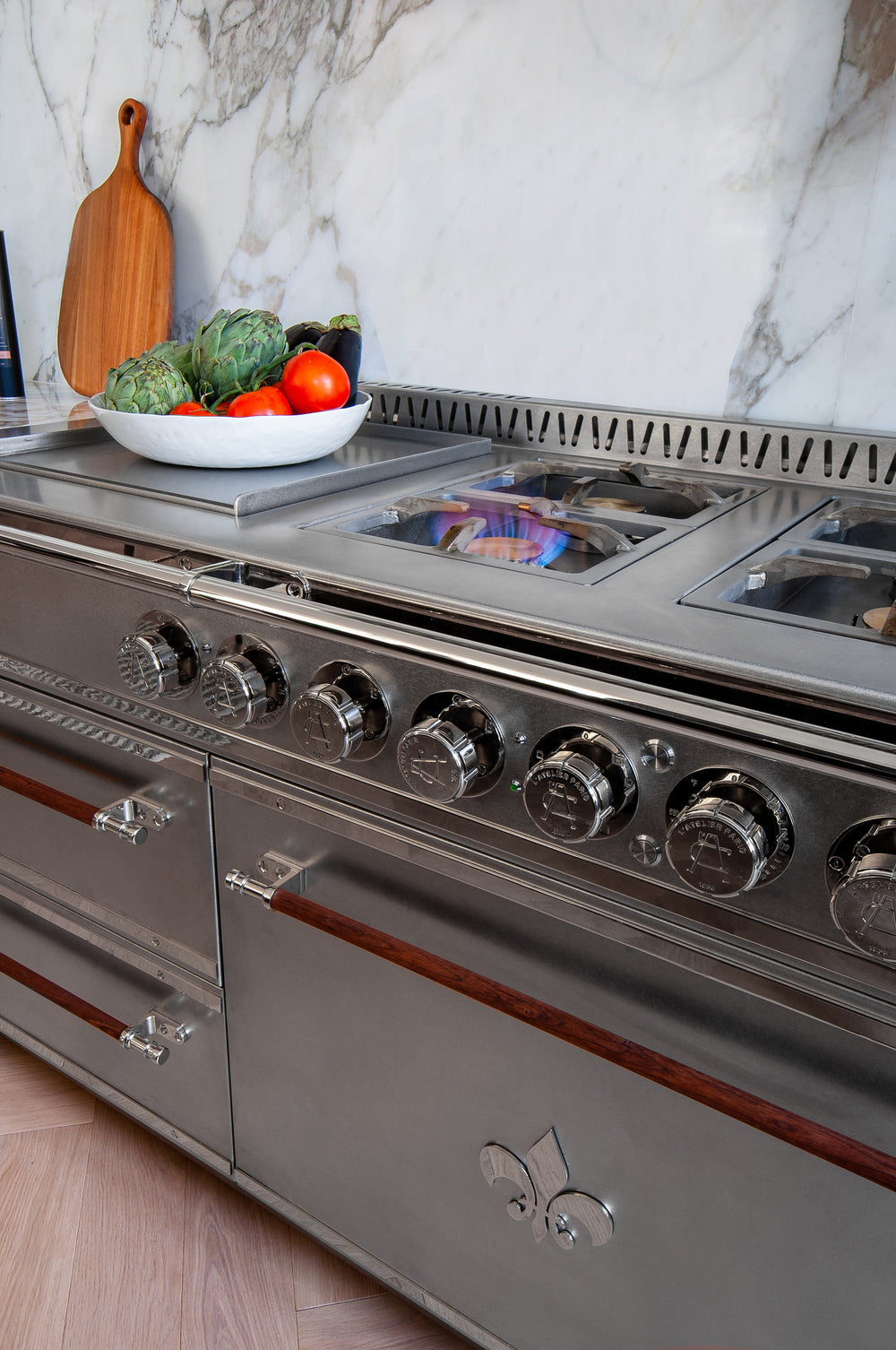
The French kitchen has been the reference point for serious residential kitchen design for over a century. The reasons are practical as much as aesthetic.
A French kitchen is designed to last. The range, the cabinetry, and the surfaces are all chosen for a 30–50-year lifespan. This is not aspirational; it is the expected standard. L'Atelier Paris backs every range with a 10-year warranty and designs every product for straightforward long-term serviceability.
Everything in a French kitchen is made to be looked at closely and to improve with age. Handcrafted cabinetry. Hand-machined brass hardware. A range built by hand to a specific configuration. The quality is visible at every scale from the overall proportion of the room to the feel of a drawer closing.
A French kitchen is designed around how the client actually cooks, not around a standardised layout. The cooktop configuration Coup de Feu, open gas, induction, or hybrid — is chosen for the specific household. The island size and position is determined by workflow. The storage is configured for how the kitchen is actually used. Form follows function in the most literal sense.
A French kitchen is a room with a point of view. The range is the focal point, and the entire room is designed to support and amplify it. When it's done well, a French kitchen feels inevitable as though no other arrangement could be right. That is the signature of genuinely good kitchen architecture.
A French kitchen is not the right choice for every homeowner. Here is an honest framework for deciding whether it suits your situation:
A French kitchen is probably right for you if:
Not ready for a full bespoke kitchen? There's a starting point for that too.
A fully bespoke L'Atelier Paris kitchen is a 6–8 month project. But not every client starts there. The Prêt à Porter collection offers defined configurations — built with the same materials, proportions, and craftsmanship as our fully bespoke work — with shorter lead times and a starting investment from around $16,000. It is the right starting point for buyers who want the L'Atelier Paris standard without the full bespoke timeline.
Whether your path is bespoke, semi-bespoke, or starting with Prêt à Porter, the conversation begins the same way: a visit to one of our US showrooms, or a call with a design consultant. No commitment required.
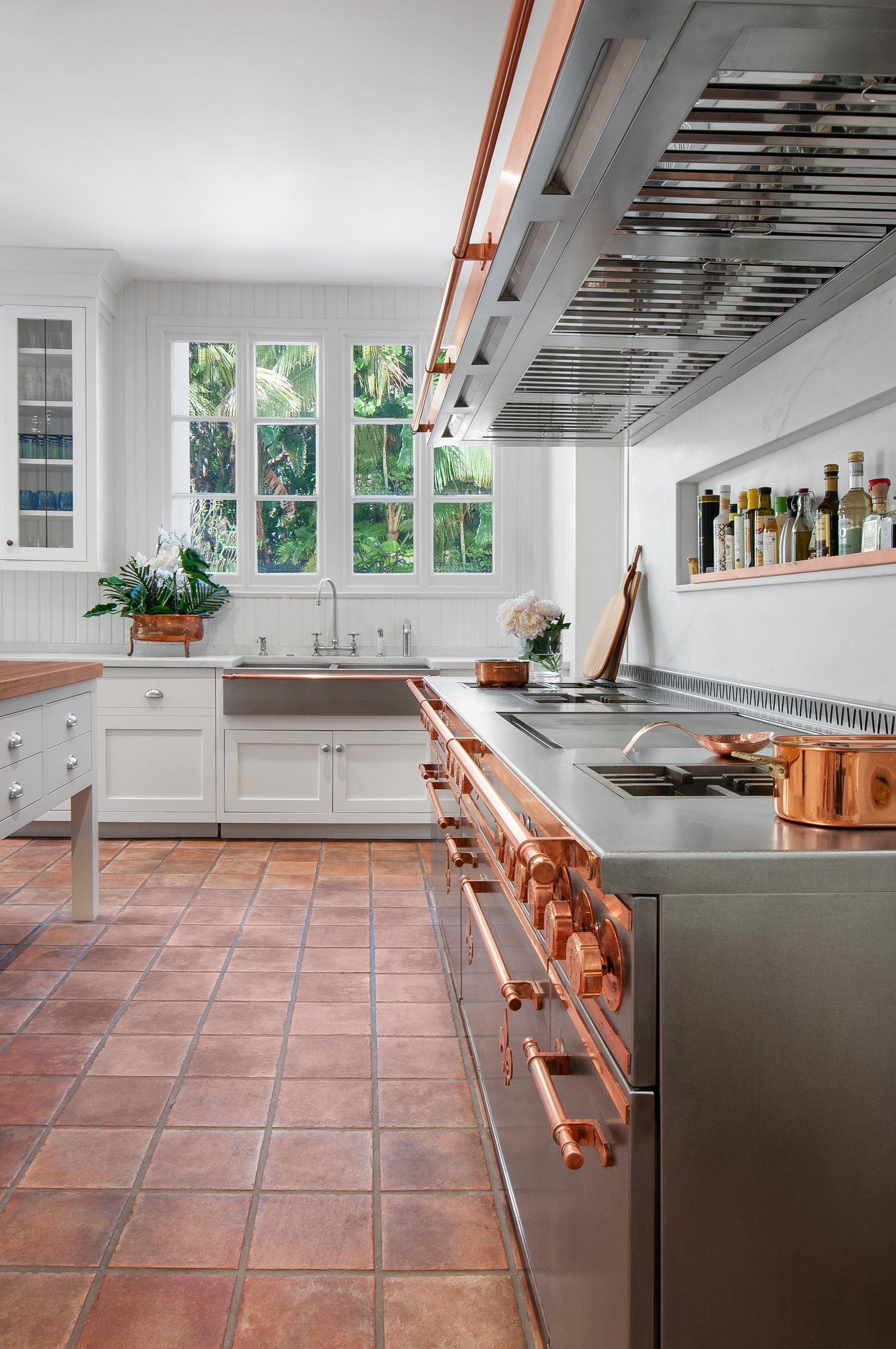
L'Atelier Paris was built on the conviction that French kitchen design should not require compromise not on size, not on colour, not on configuration, and not on lead times or warranty coverage.
Every range is manufactured at our Georgia facility and configured to the client's exact specification: fractional-inch sizing, any cooktop layout, any colour from our Signature Collection or the RAL palette, or custom paint-to-sample matched to any reference the client provides. Eleven trim finishes. A 10-year warranty. US lead times of 8–14 weeks.
The design process starts with the range and extends from there to cabinetry, islands, surfaces, hardware, and integrated appliances through a collaborative design process that typically runs 6–8 months from first consultation to completed installation.
You can see what that looks like in our completed kitchen projects. And you can begin with our range collection, which is where every French kitchen starts.

A French kitchen is a bespoke kitchen designed around the range as its permanent architectural centrepiece. It combines a custom French range, handcrafted cabinetry, natural stone surfaces, artisan hardware, and integrated appliances all specifie...

A kitchen should never begin with limitations. It should begin with imagination. For some, the perfect color begins with a fabric swatch. For others, it is inspired by a favorite piece of art, a treasured heirloom, a st...

If you have been researching luxury kitchen appliances, you have likely come across the term French cooking suite — and wondered exactly what it means. Is it just a larger French kitchen range? Is it a design style? Is it even...
